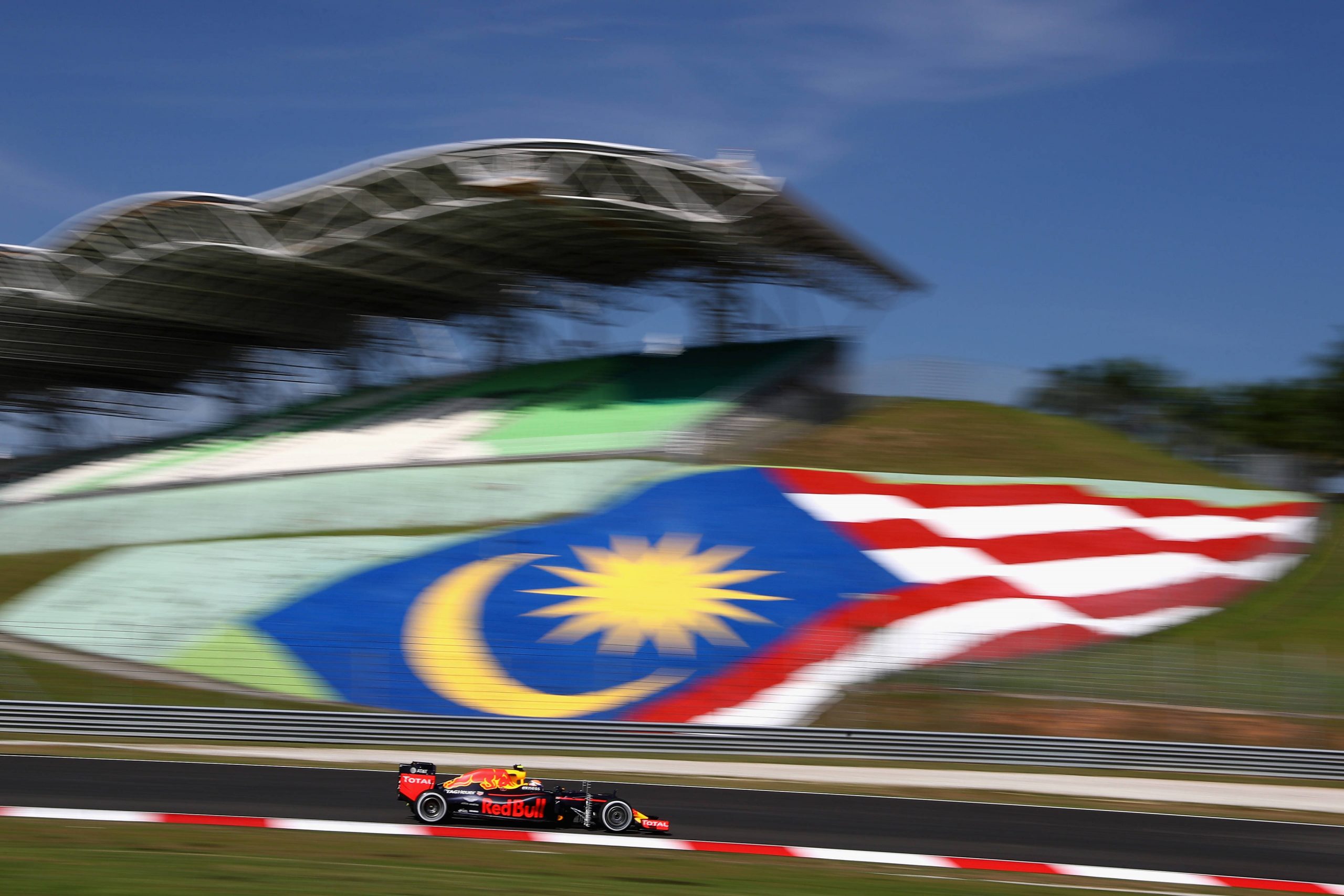
After nine years, Formula 1 returns to the Sepang International Circuit (SIC).
Yes, you read that right. In a shock turn of events, Malaysian fans have finally caught the break they’ve been waiting for since the chequered flag fell in Sepang at the 2017 Malaysian Grand Prix.
Formula 1 and the FIA have confirmed that Malaysia will host the Formula 1 Gulf Air Bahrain Grand Prix from 2nd to 4th October, slotting neatly between the Azerbaijan and Singapore Grands Prix.
While the event remains subject to official sign-off from the World Motor Sport Council, this is largely a formality. Multiple teams, SIC, and the FIA have already confirmed the news across social media.
Sepang, which debuted on the calendar in 1999, remains a beloved venue for fans both locally and abroad. More importantly, its return offers an entire new generation — myself included — their very first home race experience.
Key figures, including F1 President and CEO Stefano Domenicali, FIA President Mohammed Ben Sulayem, Bahrain’s Crown Prince and Prime Minister Prince Salman bin Hamad Al Khalifa, and Malaysian Prime Minister Dato’ Seri Anwar Ibrahim, have all expressed their excitement over this unique arrangement.
But why did Malaysia give up its right to host Formula 1 in the first place?
The Story of Formula 1 and Malaysia
For 19 years, Sepang was home to Formula 1. The inaugural Petronas Malaysian Grand Prix debuted in 1999, cementing itself as a beloved calendar staple until the final race in 2017.
Growing up, I am familiar with the story of Sepang as the brainchild of former Prime Minister Tun Dr Mahathir Mohamad. The circuit was a flagship piece of his aggressive 1990s modernisation drive — Vision 2020.
By building a state-of-the-art track next to the newly established administrative capital of Putrajaya, Mahathir aimed to project Malaysia’s technological competence onto the global stage and cement the country’s economic advantage within the region.
To execute this vision, the project was handed to German engineer Hermann Tilke. Sepang became Tilke’s very first major Formula 1 project built from scratch. It set the architectural template for the modern era of Formula 1 circuits that followed, heavily influencing the designs of tracks such as Shanghai, Bahrain, and Singapore.
Apart from its impressive technical layout, Sepang also delivered some of the sport’s most unforgettable moments.
One of the wettest races in Formula 1 history (2009)
The 2009 Malaysian Grand Prix remains one of the wettest races in the sport’s history. It was cut short by a massive, torrential monsoon downpour. As a result, only half points were awarded.
Perez hunting Alonso for his maiden win (2012)
In treacherous wet-to-dry conditions, a young Sergio Perez relentlessly hunted down Fernando Alonso’s Ferrari. He nearly secured his maiden win before running wide at Turn 14, resulting in a second place finish. That marked his first-ever career podium finish in Formula 1.
The “Multi 21” Controversy (2013)
Red Bull issued the coded instruction “Multi 21” (meaning car #2, Mark Webber, stays ahead of car #1, Sebastian Vettel) to maintain a 1-2 finish. The German blatantly ignored the order, leading to a frosty and now-infamous post-race confrontation.
Lewis Hamilton’s Engine Failure (2016)
During an intense championship fight, Lewis Hamilton’s Mercedes spectacularly expired in flames. The engine failure prompted his famous “Oh no, no!” radio message.
When Formula 1 last raced in Sepang, Max Verstappen won the race. (Photo Credit: Red Bull Content Pool)
2017: The last time Formula 1 raced in Sepang
For many locals, myself included, Formula 1 used to be a niche interest. We knew the race happened in our backyard, but there was rarely a strong desire to attend. The local excitement simply did not mirror the fever pitch we see today.
Most fans naturally gravitated toward the more accessible and culturally relevant MotoGP. Worse, Sepang’s Formula 1 events relied heavily on corporate ticket quotas. This created an illusion of demand rather than cultivating an authentic, grassroots fanbase.
Eventually, the financial reality set in. With the annual hosting fee ballooning to an estimated RM300 million (roughly US$74 million), ticket sales simply could not sustain the cost.
In 2016, the race drew just 45,000 spectators to a venue built to hold 120,000. Faced with this massive financial drain, the Malaysian government negotiated a mutual agreement to relinquish its hosting rights a year early.
“I think we should stop hosting the F1. At least for a while. Cost too high, returns limited. When we first hosted the F1 it was a big deal. First in Asia outside Japan. Now so many venues. No first mover advantage. Not a novelty.” — Former Youth and Sports Minister, Khairy Jamaluddin
Fresh Competition from Abroad
There was competition too. When Singapore debuted its flashy, inner-city night race in 2008, it instantly captured the region’s attention. While Sepang remained a traditional, hot afternoon track event, it subsequently lost its regional monopoly on the spectacle.
Knowing 2017 would be the final race, organisers desperately wanted to avoid empty grandstands. To push attendance up and recoup costs, SIC slashed ticket prices for Malaysians by a massive 82%.
For the first time, fans could grab hillstand tickets for as little as RM58 (roughly US$14), while premium main grandstand seats dropped to RM336 (roughly US$82). The aggressive price cuts worked to an extent. Attendance improved for the season finale, pulling in roughly 80,000 spectators, but it still fell far short of a sell-out.
Fortunately, the 19th and final Malaysian Grand Prix delivered exactly the kind of unpredictability Sepang was famous for.
A day after his 20th birthday, Max Verstappen claimed the second victory of his career by hunting down reigning World Champion Lewis Hamilton with an aggressive pass on Lap 4 into Turn 1. Meanwhile, after an engine failure in qualifying relegated him to dead last on the grid, Sebastian Vettel sliced through the field in his Ferrari to finish a hard-fought fourth.
The final race in Sepang also ended with a bizarre twist. During the post-race cool-down lap, Vettel and Williams rookie Lance Stroll inexplicably collided. The impact ripped the left-rear wheel off Vettel’s Ferrari, forcing him to hitch a comical ride back to the pit lane on the sidepod of Pascal Wehrlein’s Sauber.
The intense 2021 championship and a new wave of fans brought in by Drive to Survive have completely transformed the sport on a global scale. (Photo Credit: Mercedes AMG Petronas F1 Team)
What has changed since then?
In hindsight, we let Sepang go at the wrong time. When Liberty Media took over Formula 1, their masterstroke was partnering with Netflix to launch Drive to Survive in 2019.
The series fundamentally changed how fans interact with the sport. Formula 1 was no longer just about speed — it became about the humans in the paddock. The series highlighted the personalities, rivalries, and human stories behind the helmets.
Despite mounting criticism as the series progressed, the data makes one thing clear: Drive to Survive worked. Today, 43% of the global fanbase is under 35 (a 30% increase since 2018). Female fans now make up roughly 40% of the audience — a massive leap from just 8% back in 2017.
Add to this the cultural momentum brought by the intense 2021 championship battle between Lewis Hamilton and Max Verstappen.
By mixing a genuinely thrilling, down-to-the-wire sporting rivalry precisely as Drive to Survive bred a new wave of fans into the ecosystem, this era cemented Formula 1’s transition from a niche European motorsport into a mainstream, global pop-culture phenomenon.
Back home, this global shift resonated loudly. The fandom evolved drastically from the corporate-heavy, elite-focused crowds of the early 2010s.
Today, Malaysian fans are younger, digitally engaged, and deeply invested in the personalities on the grid. Social media and content creators have built vibrant local communities, proving that the passion for the sport exists.
Despite this massive resurgence in popularity, a return to Sepang was never a guarantee. As recently as August 2025, the idea resurfaced in Parliament.
“Organising F1 races requires the government to pay about RM300 million (roughly US$74 million) annually to Liberty Media, which holds the F1 commercial rights. Malaysia must also bind itself to a contract of between three to five years with the said company, amounting to a commitment of about RM1.5 billion (roughly US$370 million) during this period.” — Hannah Yeoh, Former Youth and Sports Minister
Acknowledging the prestige of Formula 1, Yeoh admitted it was “good to have” but noted the massive funding required could be better spent supporting other sports.
Yet, despite the financial roadblocks, the door was never entirely closed on the possibility of Formula 1 returning to Sepang.
How Sepang made it surprise comeback
The ongoing Middle East conflict proved to be the unexpected catalyst for Sepang’s return.
Escalating tensions had already forced the cancellation of the April races in Bahrain and Saudi Arabia, creating a massive five-week void in the calendar. As hostilities continue, Formula 1 is at risk of losing the upcoming races in Qatar and Abu Dhabi too.
Financially, Liberty Media stood to lose approximately US$150 million in premium hosting fees if they cancelled both races. Dropping below 24 races also risked triggering massive TV penalties with networks like Sky Sports and ESPN, potentially pushing total losses to US$350 million.
Turkey, Portugal, Japan, and Singapore were among the circuits Formula 1 considered to fill the gap — but none were viable options.
Though the sport has relied on European circuits like Portimão (Portugal) and Istanbul Park (Turkey) as emergency stand-ins in the past, pulling off a flyaway race weekend on such short notice would be a logistical nightmare.
Sepang, on the other hand, was logistically flawless. Located right next to an international airport and sitting 300 kilometres from Singapore, Formula 1 could execute a seamless, cost-effective turnaround for the Southeast Asian leg.
An even bigger advantage was that SIC maintained its stringent FIA Grade 1 certification.
The track was already kept to world-class standards for other racing series such as MotoGP and the Asian Le Mans Series. Malaysia only needed to spend a fraction of the usual cost to ensure the circuit was ready to welcome Formula 1’s return.
Yet, even with the logistical stars aligning, this return was never guaranteed. The Malaysian government had other global events to prioritise. It was also highly unlikely Sepang would host a race if taxpayers had to foot the bill.
Enter Bahrain
Determined to keep its race title and commercial presence alive despite the regional conflict, the Gulf state agreed to absorb the substantial upfront payment to the FIA.
This created a highly unusual but brilliant compromise: Malaysia provides the circuit, and Bahrain provides the cash. Without Bahrain’s financial backing, this homecoming would have been dead on arrival.
“The initial payment of hundreds of millions of ringgit had already been paid to Formula One by Bahrain. We do not have to pay it. We are effectively hosting it for free. If there is any expenditure, it is only to carry out minor repairs to the track, which is currently used for other racing events. I expect that to cost between RM10 million and RM16 million. (roughly US$2.4 million and US$3.9 million)” — Prime Minister Datuk Seri Anwar Ibrahim
This is why the October event is officially titled the Formula 1 Gulf Air Bahrain Grand Prix.
The best part? If the 2026 Bahrain Grand Prix proves commercially successful, it could prompt Formula 1 and the FIA to replicate this arrangement should similar circumstances arise.
More importantly, it would force the Malaysian government to seriously reconsider whether now is the time to push for Sepang’s permanent return to the Formula 1 calendar.
The return to Sepang offers a brutal test, one that will stretch the current regulations and the drivers to their absolute limits. (Photo Credit: Mercedes AMG Petronas F1 Team”)
The cure stifling modern F1
Since the announcement, the global Formula 1 community has been buzzing with excitement — and for good reason.
For starters, Sepang’s layout offers a unique technical challenge. Instead of handing out time penalties for track limits, the circuit punishes mistakes immediately: push too hard and drivers are beached in deep gravel and grass. Yet the track is also exceptionally wide, giving the modern generation of cars plenty of room to battle it out.
October in Malaysia also brings the monsoon season, where weather conditions can shift at any moment. Plus, the brutal heat and humidity have long been a talking point among drivers who have raced here.
The relative lack of heavy braking zones, paired with two long straights near the grandstand, will be the ultimate stress test for the current generation of energy-starved cars. With track temperatures exceeding 50°C and humidity above 80%, the conditions will also push Formula 1’s heat-sensitive lithium-ion batteries and MGU-K systems to their absolute limits.
A Fresh Challenge
What’s more, over half the grid has never raced at Sepang. Young stars like Lando Norris, Charles Leclerc, and Kimi Antonelli will go against veterans such as Max Verstappen, Lewis Hamilton, and Fernando Alonso, who boast years of experience racing on this tarmac.
Ultimately, Sepang was built for motorsport fans. For years, it has been at the heart of grassroots Malaysian racing, continuing to serve the country today.
“Formula 1 returning to Malaysia is a great moment for Asian motorsports given that the track remains a favourite and is still running races for other categories such as MotoGP. As a Malaysian, I am excited to see the return of our home race to the calendar.” — Insight from a long-time Malaysian Formula 1 fan
2026 marks a chance for a new generation of fans to finally take their passion to the track. As someone who only discovered the sport shortly after Malaysia gave up its hosting rights, it has always been a dream to experience a home race.
And now, that dream is a reality. Formula 1 returns to Malaysia this October for the 2026 season.
**
Formula 1 returns August 23rd in Zandvoort.
Featured Image Credits: Getty Images/ Red Bull Content Pool