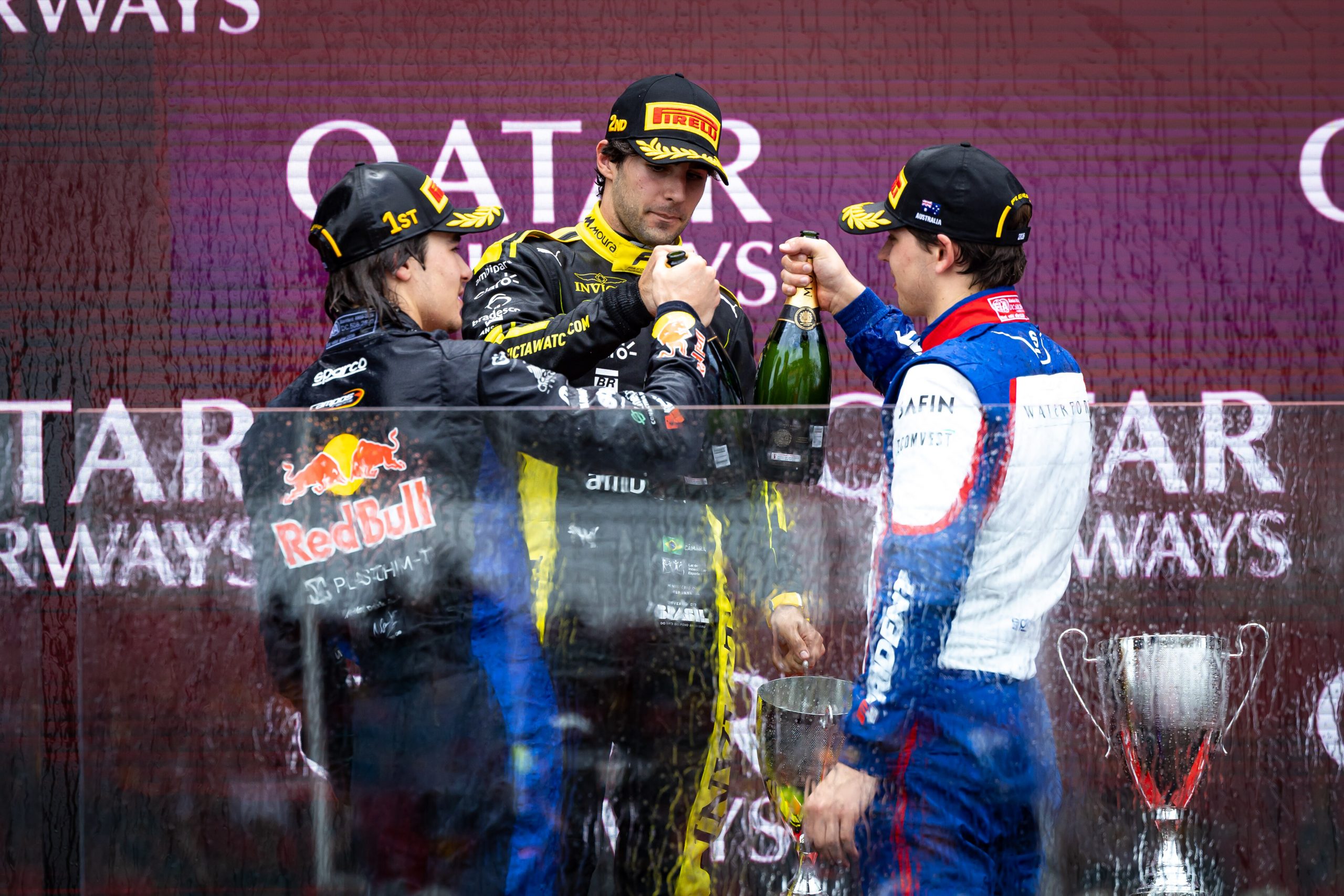
The Feeder Series in Melbourne delivered plenty of drama despite Formula 1 taking most of the headlines in Australia. Formula 2 and Formula 3 returned to Albert Park with new grids, rising talents and the chaos that often defines the start of a junior season.
Across both championships we saw dominant victories, breakthrough performances and a few difficult weekends for established teams. Here are the main talking points from the Formula 2 and Formula 3’s season opener in Australia.
Tsolov’s Breakthrough — A Generation to Watch (F2)
Few victories at the start of a Formula 2 season carry broader implications than Nikola Tsolov’s win in Melbourne.
The Campos Racing driver delivered a composed performance to secure his first victory in the category. In doing so, history was also made as the Bulgarian became the first driver from his country to win an F2 race.
Yet the result was notable for another reason.
The Melbourne Feature Race podium was effectively occupied by an entire new generation of Formula 2 drivers.
Tsolov led the race home ahead of Invicta Racing’s Rafael Câmara and TRIDENT’s Laurens van Hoepen. All three are competing in their first full Formula 2 seasons, even if a few of them had limited appearances late in the previous year.
In a championship that traditionally rewards experience, such a podium felt significant. The foundation of Tsolov’s victory was established immediately after the start. Launching from fifth on the grid, he climbed to third before the field completed the opening lap.
Soon afterwards, the race began to change shape.
Three drivers at the very beginning of their Formula 2 journeys had shared the podium in the opening round of the season. For a category designed as Formula 1’s final proving ground, the result served as an early signal that a new group of contenders may be emerging.
If Melbourne offered the first glimpse of the 2026 title fight, it also hinted at something larger.
A new generation of Formula 2 drivers may already be announcing itself.
“I know there are going to be bad days, and I know there’s going to be good ones. I’ll just try to stay as consistent as possible throughout the year. And I think that’s what’s going to get us the Championship.” – Nikola Tsolov
Beganovic’s Melbourne Collapse – When Pole Means Nothing
While Melbourne’s Feature Race podium showcased drivers just beginning their Formula 2 journeys, the weekend told a very different story for one of the grid’s more experienced names.
Dino Beganovic arrived in Australia with expectations. Unlike several rivals around him, he already knew the category and its demands. Qualifying suggested those expectations had strong foundations.
Under pressure, the Swede delivered a superb final lap and secured pole position for the Feature Race. Around Albert Park, that advantage usually creates the strongest possible starting point for Sunday.
However, Formula 2 rarely rewards assumptions.
Saturday’s Sprint Race delivered the first warning. The reverse-grid format quickly dragged Beganovic into dense midfield battles where track position became difficult to control.
Soon afterwards, positions began to slip away. The points never came.
Sunday initially hinted at redemption.
After a difficult start, Beganovic began rebuilding his race. By lap 14, he had caught Rafael Câmara and passed him for second place at Turn 11.
For a moment, the recovery looked real. Then everything changed.
Two laps later, the DAMS driver slowed dramatically and pulled off the circuit at Turn 10. A reliability issue ended the race before the fight at the front could fully develop.
The retirement triggered a virtual safety car and later a full safety car period.
By that stage, the contrast across the field had already become clear.
A new generation stood on the Melbourne podium. Meanwhile, one of the more experienced drivers left Australia without a single point despite starting the weekend on pole.
Such swings define Formula 2.
Melbourne simply offered another reminder that the perfect beginning can unravel in only a few laps.
Campos Set the Melbourne Benchmark Across F2 and F3
If one team left the Melbourne feeder series weekend looking like the early benchmark across the ladder, it was Campos Racing.
That reputation did not grow from hype. It grew from results. Campos won both Feature Races of the weekend, with Nikola Tsolov triumphing in Formula 2 and Ugo Ugochukwu doing the same in Formula 3. At a season opener, such a double rarely happens by chance.
Just as importantly, the pace appeared throughout the weekend.
In Formula 3, Campos showed speed from the opening session. Ugochukwu set the fastest time in Free Practice, and the team then locked out the front row in qualifying. Théophile Naël edged his teammate to pole by just 0.021 seconds. VAR eventually left Melbourne leading the Teams’ standings thanks to its Sprint result, yet Campos still delivered the strongest Feature Race performance of the round.
Tsolov’s Feature Race victory was already covered earlier.
The result did not arrive in isolation. Campos entered the season as the reigning 2025 Formula 3 Teams’ Champions. That title followed what the championship described as the most successful campaign in the team’s F3 history. Six wins and consistent podium finishes secured their first teams’ crown.
Continuity also played a role in that success. Tsolov already knew the organisation well. He helped Campos win that F3 title before moving up to Formula 2 within the same structure.
Because of that stability, Campos already looks settled and cohesive.
That combination often proves decisive in junior categories. Raw speed matters, but execution usually decides championships. When one organisation starts fast in both F2 and F3, wins on Sunday, and carries momentum from the previous season, the message becomes clear.
Campos may not simply rank among the teams to watch in 2026.
They may already represent the benchmark everyone else must chase.
Sprint Races Still Reward the Opportunists (F2)
While Feature Races usually define the championship narrative, Sprint Races often reward a different type of driver.
Melbourne provided another clear example. Joshua Dürksen emerged from Saturday’s Sprint Race with victory after a composed drive through the chaos that frequently accompanies reverse-grid racing. Starting from the front of the inverted grid, the Paraguayan managed the race calmly while others around him struggled for rhythm.
In Formula 2, that skill often proves decisive. Sprint races compress the field and reduce strategic variables. With fewer pit stops and tighter track positions, small mistakes quickly become costly.
Drivers who control restarts, tyre wear and early-lap aggression usually gain the advantage. Dürksen executed that formula almost perfectly.
The result also carried a small historical note. The Invicta Racing driver secured a second consecutive victory in the Melbourne Sprint Race.
Yet the Sprint Race told another story further down the order.
Gabriele Minì produced one of the strongest recovery drives of the weekend. Starting from the back of the grid in 21st place, the Italian carved his way through the field to finish in sixth.
Overtaking at Albert Park remains notoriously difficult, particularly in junior machinery where tyre management becomes critical. Minì nonetheless found a rhythm and consistently gained positions throughout the race.
Together, those performances reinforced one of Formula 2’s enduring traits.
Feature Races reveal the championship contenders.
Sprint Races, however, often reveal the drivers who thrive when the order becomes unpredictable.
Melbourne’s Early Signals for the Feeder Ladder
Season openers in junior categories rarely provide definitive answers.
However, they often reveal patterns. Melbourne offered several.
First, the weekend hinted at a generational shift. The Formula 2 Feature Race podium showcased drivers only beginning their full campaigns in the category. Tsolov, Câmara and van Hoepen may still lack experience, yet their performance suggested confidence well beyond it.
That trend extended beyond a single race result.
Formula 3 produced similar signs. Ugo Ugochukwu claimed his first Feature Race victory, while Campos Racing demonstrated the kind of organisational strength that usually underpins championship campaigns.
Momentum matters in junior series.
Teams that start quickly often shape the early rhythm of a season. Campos appears to understand that reality better than most. With victories in both Formula 2 and Formula 3 Feature Races, the Spanish squad left Melbourne looking organised and immediately competitive.
Elsewhere, the weekend reminded observers how fragile early success can be.
Beganovic’s pole position quickly transformed into a pointless weekend. Meanwhile, Sprint Race chaos once again rewarded drivers who adapted fastest to unpredictable conditions.
Such contrasts define life in Formula 2 and Formula 3.
Talent alone rarely guarantees results. Execution, consistency and timing often prove just as important. For young drivers chasing Formula 1, that lesson arrives quickly.
The Melbourne feeder series weekend may have been only the opening round of the season. Yet across both championships, the weekend already suggested the shape of the months ahead.
A new generation is rising.
And the fight to reach Formula 1 has already begun.
The plan was for F2 and F3 to appear next in Bahrain on April 10th, but we’ll have to wait and see what happens with that.
*
Feature Image: Red Bull Content Pool