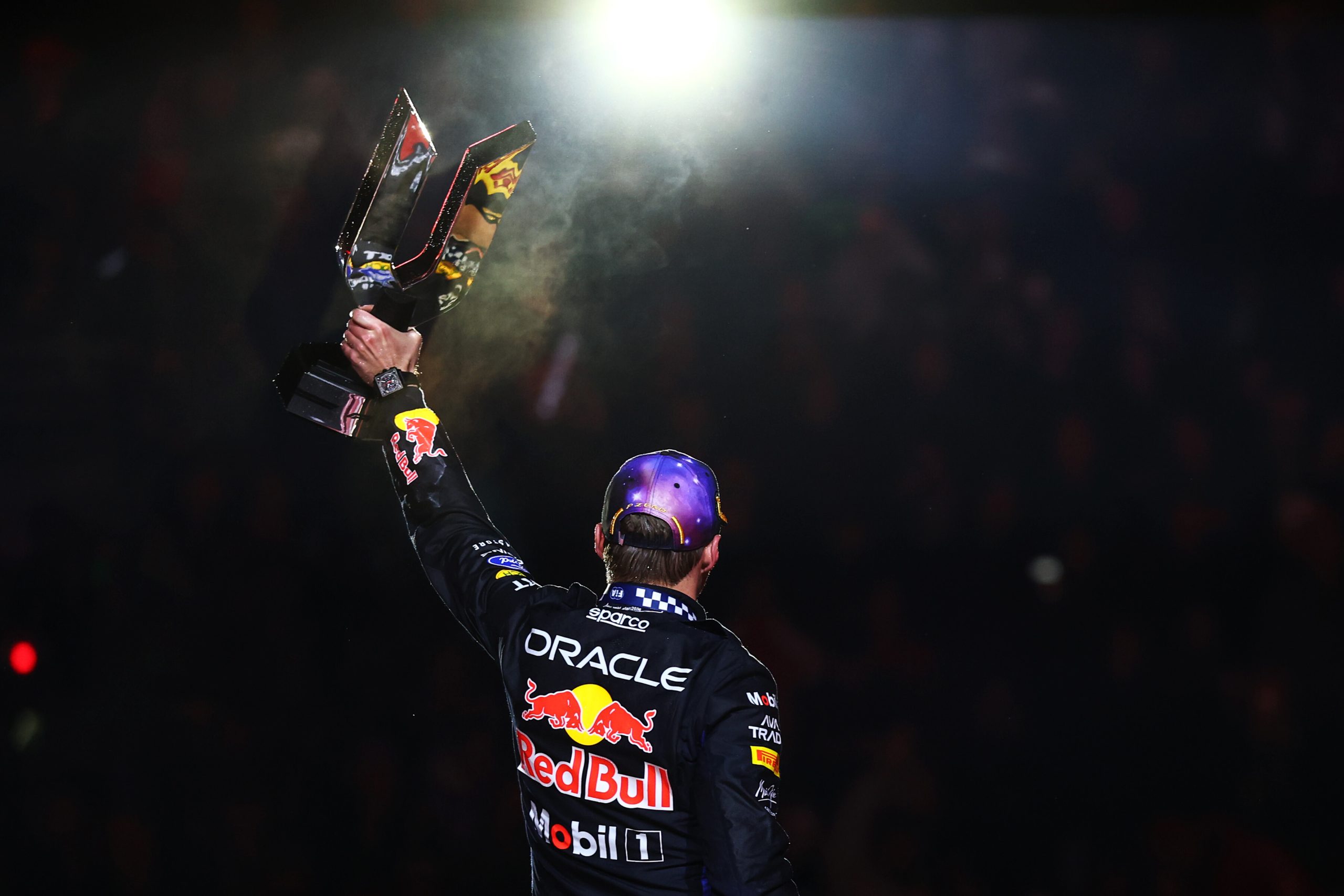
Formula 1’s 2026 trip to Las Vegas gave the crowds on the Strip possibly one of the most unusual races in quite some time. Where watchers have become accustomed to fewer overtakes or a more predictable result, Sin City provided a race that stayed in doubt until the closing laps. After a chaotic Friday with rain disrupting that all-important practice time, rivalries that had been bubbling away reared their heads across the weekend, turning heads up and down the paddock. For organisers who had faced doubts over ticket demand, the weekend also offered a glimpse of what could keep fans coming back to Vegas during one of the most kooky, flashy weekends of the calendar – a race that was ever-changing, offering some valuable points to those in need, while others were left in the Nevada dust.
A Torrential Thursday put a Premium on Friday Practice
Verstappen described the surface as “an ice rink” after venturing out on Thursday. With both opening sessions affected by rain, the vast majority of teams went into final practice with two jobs competing for the same hour, desperately looking to make up lost ground. The drivers needed to find their braking points on slick tyres before Qualifying – while engineers needed longer runs to judge how those tyres would hold up on Saturday night. It was a game of chess on a now-dry Las Vegas street circuit.
Mercedes, as they have been over the course of the season, were one of the first to make in-roads, producing the clearest indication of pace across both conditions. Russell topped the wet second session, followed up by the fastest stint again this time in the dry, nearly a second ahead of the 2026 World Chmpion Kimi Antonelli. Antonelli subsequently set the fastest time in qualifying – although Verstappen inherited pole due to Antonelli’s five-place grid penalty for an over-allocated power unit. However, by then, Verstappen would find that an incident on one of Russell’s preparation laps had drawn as much attention as anything he had done against the clock.
Russell and Verstappen Took Their Spat Onto the Strip
The final practice session sowed the seed for one of the weekend’s biggest talking points; approaching Turn 14, Verstappen braked earlier than Russell expected and changed direction. Russell moved to the inside and the cars touched. Both men raised the informal agreements drivers use to make space before a flying lap, and while te stewards based their ruling on the movement of the Red Bull under braking and issued Verstappen a warning, choice words were issued by the drivers afterwards, re-igniting an old spat which seems to lie dormant for months at a time.
On race night, the layout gave their rivalry another dimension – a Mercedes could use the tow to edge ahead by the start-finish line; Verstappen could then reclaim the lead under braking for Turn 1. By ten laps to go, Verstappen was already asking Red Bull how to protect himself on the run to the flag to avoid a last-second loss. His rivals had begun to work out where he was deploying electrical energy, and a pass at Turn 1 would be no use to him once the race was over.
Russell is Sticking To His Guns
That, then, explains the move that put Russell in the wall; with Antonelli between him and Verstappen on lap 48, Russell was determined to get past his teammate to start the final lap directly behind the Red Bull. The Brit attacked at Turn 5, locked up and slid into the barrier. Although he found reverse and rejoined,he finished ninth with a dunt to the car – but. was there a dunt to his ego to match? Russell said afterwards that he had no regrets about attempting the pass. He knew where he wanted to be to win the race, and quite simply got the braking wrong.
Verstappen, however, had seen the crash in his mirrors, and when asked about Russell in the post-race press conference, he dismissed the Mercedes driver as “so far below my level” and delivered his verdict on the accident: “And today karma is a bitch.” There was a championship consequence beneath the personal jibe. With Antonelli already champion, the two were fighting for second in the standings. Verstappen took 25 points to Russell’s two, a 23-point swing on a night when Russell had been within touching distance of victory.
Mercedes Lost Two Podiums in Three Laps
While Russell’s costly mistake saw one podium slip from Mercedes’ fingers, Antonelli still had a shot at Verstappen for the win – that was, until the Italian lifted off the throttle before Turn 14 on the penultimate lap. The youngster wanted to stay in Verstappen’s slipstream and save his attack for the final lap, but when he briefly reapplied the throttle, the Mercedes’ hybrid system failed to recover energy as he expected. “I exited the corner at zero battery,” he explained afterwards. With no electrical boost available, Antonelli said he lost almost two seconds on the straight. Norris and Piastri both swept past, leaving him fourth.
McLaren, close behind in a relatively unexpected turn of events, had earned the chance to profit. Norris had passed Russell for second as early as lap 33, and Piastri had worked his way into the leading group. When Mercedes faltered, both were close enough to act, when in the fourth-fastest car on the high-speed track. Less than a second separated the McLaren drivers at the finish, but Norris would be the victor of the two.
Ferrari’s Problems Are Coming From Inside the House
Lewis Hamilton had already picked up a ten-second penalty for leaving the track and gaining an advantage against Norris when the Ferrari driver’s night got even worse. In fact, it seems to be becoming even less of a surprise when the Ferrari team are suffering at the hands of their own personnel. Charles Leclerc in the second Ferrari tried to take a place back from him at Turn 7, but the two touched – Hamilton spun, seeing him tumble down the standings. The stewards found Leclerc wholly responsible and gave him a ten-second penalty of his own. Sixth across the line became tenth in the results, three places behind the team-mate he had tried to pass.
Vegas alone makes a thin case for changing Ferrari’s line-up. The stewards held Leclerc responsible for spinning Hamilton at Turn 7, but the incident also exposed a weakness in how Fred Vasseur manages the pair. He had already spoken to both drivers after a very similar incident in Mexico City, and a reminder to think of the team still left each man to decide how much risk was acceptable. Before Ferrari considers replacing a driver or its team principal, Vasseur has a simpler change to make: when the points at stake outweigh the benefit of a pass, tell the drivers to hold position.
A Sign of the Times?
To add insult to injury, the points sheet gave Ferrari a painful comparison for its debrief. Pierre Gasly and Franco Colapinto brought the Alpines home fifth and sixth, collecting 18 points between them. Hamilton and Leclerc took seven. After yet another collision between its drivers and trouble brewing behind the scenes, Ferrari left Vegas with questions the stewards’ verdict could only partly answer. When its cars meet on track, how much risk is the team prepared to let them take, and will this pairing work together towards the goal of a World Championship over their own successes?
Vegas’ Strongest Sales Pitch?
By yesterday morning, Formula 1 had two numbers to celebrate in Las Vegas; a Saturday sell-out and 352 overtakes. But, a third, more controversial figure deserved as much attention. In the run-up to the race, buyers on resale platform TickPick had paid an average of $781 for a Saturday ticket, down from $889 last year and $1,214 for the inaugural race in 2023. Even after that 36% fall, the cheapest Saturday ticket available on the platform was $470. Vegas had become considerably cheaper and was still an expensive place to watch a motor race.
Five days before the race, the cheaper single-day general admission tickets had sold out while grandstand seats were still available from the promoter. There was clearly an appetite for F1 at an accessible price – but the bells and whistles included in Vegas are not necessarily as palatable to the average petrolhead. The resale figures suggest a limit to what fans would pay for the privilege of seeing it on the Strip – and looking at the lead-up to the weekend, cold weather and two settled championships gave buyers reasons to stay home. Seven partnership announcements and a celebrity race in illuminated Lego cars gave sponsors plenty to do once they arrived, but fans contemplating a $470 ticket were entitled to ask what was in it for them.
An Interesting Palate Cleanser?
Sunday’s answer was a grand prix that occasionally resembled the Formula Ford Festival with the new generation of cars proving to have changed the Vegas game entirely. The slipstream was so powerful that a Mercedes could sweep past Max Verstappen, lead across the line and surrender the place again at Turn 1. It was an exciting watch, but some passes seemed to have, bizarrely, a disposable quality. As Lando Norris put it, “you press boost and you go past someone”. The real sporting value lay in what the overtake count missed; Verstappen working out how to defend the final run to the flag, and George Russell risking a podium to be the driver in his tow, and a drag race to the flag where the Championship-winning car was pipped to the post by Carlos Sainz’s Williams. Whether it was worth $781 to watch in person is a question a sold-out sign answers only for the people who could afford to be there.
*
Formula 1 returns on 27th November for the Etihad Airways Abu Dhabi Grand Prix.